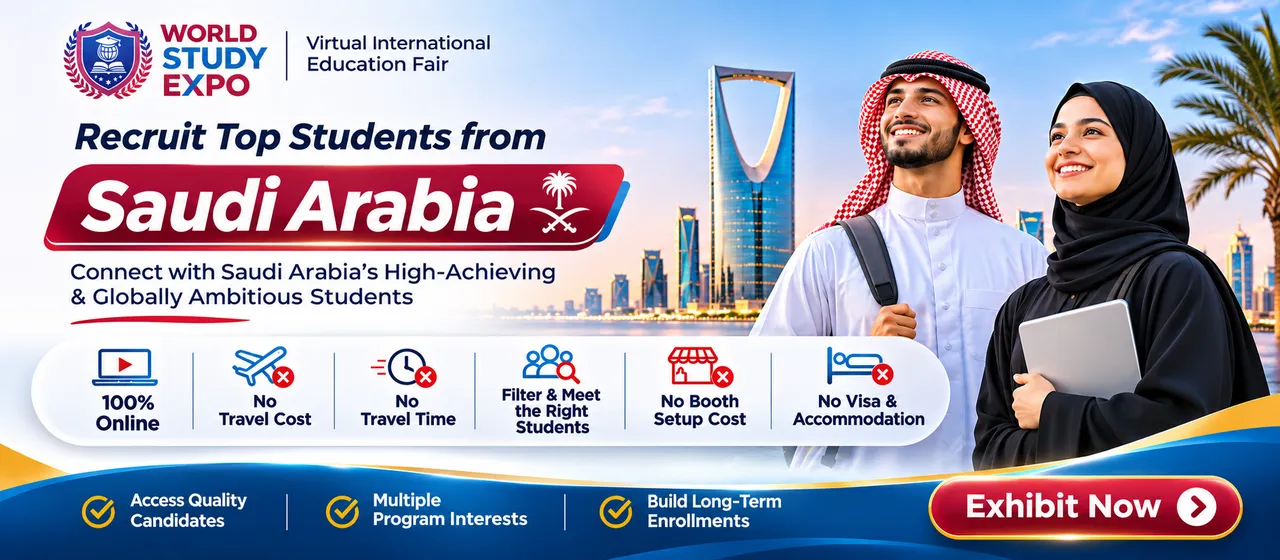
How can universities recruit students in Saudi Arabia?
Universities recruit in Saudi Arabia by combining recognition with scholarship sponsors, a small number of trusted agents, and direct contact with students and parents. Through World Study Expo, institutions join the Saudi Arabia online edition on 7–10 October 2027 and meet students from every region of the Kingdom in one-to-one video appointments. Students book those meetings having stated their subject, level and intended intake, so each conversation starts with a qualified applicant.
- people in Saudi Arabia
- 32.2m
- of Saudi nationals are under 30
- 63%
- scholarship target at the world’s top 200 universities by 2030
- 70,000
- Saudi Arabia online edition, 7–10 Oct 2027
- 4 days
Why Saudi Arabia is a priority market for international recruitment
Saudi Arabia has the largest population in the Gulf and one of the youngest. The 2022 census counted 32.2 million residents, and 63% of Saudi nationals were under 30. That is a large, ambitious cohort moving through secondary school and university at the same time as the economy is being rebuilt around new industries.
Education sits at the centre of that plan. The Human Capability Development Program, one of the Vision 2030 programmes, links study to the skills the Kingdom needs. In 2022 the government relaunched the Custodian of the Two Holy Mosques Scholarship Program with a sharper focus: fewer, better-targeted awards, organised in tracks, aimed at highly ranked institutions and priority subjects. The Ministry of Education set a goal of 70,000 scholarships at the world’s top 200 universities by 2030.
Sponsored students are only part of the picture. Families increasingly self-fund, employers sponsor staff for postgraduate study, and a growing number of students compare an international degree directly against new private and branch-campus options at home. International student recruitment in Saudi Arabia now rewards institutions that can explain, quickly and specifically, why their programme is worth leaving the Kingdom for.
What has changed since the 2010s
- Scholarships are more selective and tied to rankings and subject priorities
- Self-funded and employer-funded students are a larger share of demand
- Domestic provision is stronger, so the comparison is sharper
- Employer-sponsored postgraduate and MBA demand is significant
How a Saudi student’s shortlist is decided
Saudi families tend to test an institution in the same order. An institution that fails an early question rarely gets to the later ones, however strong its teaching. Prepare for them in this sequence.
Recognition
“Is your university recognised, and is it on the sponsor’s list?”
Asked first and often decisive. Bring accreditation documents, current ranking positions and, where you have it, evidence that Saudi sponsors have funded students with you before.
Subject fit
“Does this programme lead to work in the Kingdom?”
Families weigh programmes against the jobs Vision 2030 is creating. Show graduate outcomes and industry links, not only course content.
English route
“What if my IELTS score is half a band short?”
Proficiency varies widely. Name the score, the pathway or foundation option, its length, and whether progression is guaranteed.
Family assurance
“Where will she live, and who will look after him?”
Accommodation, safety, prayer facilities, halal food and the size of the existing Saudi community are core questions. Answer them in detail.
Where Saudi student demand sits, beyond Riyadh and Jeddah
Most recruitment trips cover Riyadh, Jeddah and the Eastern Province. Students in the south, the north and Qassim are just as ambitious, and see far fewer international universities. An online edition reaches every one of these regions on the same terms.
Central
Riyadh, Qassim (Buraydah, Unaizah)
The capital is the most visited market. Qassim students see far fewer international institutions.
Western
Jeddah, Mecca, Medina, Taif
Large and commercially diverse; strong interest in business, health and hospitality.
Eastern Province
Dammam, Khobar, Dhahran, Al Ahsa
An energy and engineering economy; high demand for engineering, computing and postgraduate study.
Southern
Abha, Khamis Mushait, Jazan, Najran
Substantial student populations with little direct contact from overseas universities.
Northern
Tabuk, Hail, Al Jouf, Arar
Rarely on a recruitment itinerary; new tourism and infrastructure projects are reshaping local ambitions.
Which subjects Saudi students want to study abroad
Demand follows the jobs the Kingdom is creating. Engineering, computing and artificial intelligence, health sciences, and business and finance remain the largest categories, and they are also the most crowded with international competitors.
Faster-growing interest sits in subjects linked to new sectors: tourism and hospitality management, environmental science and renewable energy, sports management, urban planning, and the creative and entertainment industries. Institutions with genuine strength in these areas often meet less competition and more curious, well-prepared applicants.
Postgraduate demand is significant, particularly taught masters degrees and MBAs for working professionals, many of them employer-sponsored. Undergraduate applicants arrive with parents, and foundation years matter far more to them.
- Engineering
- Computing & AI
- Health sciences
- Business & finance
- Tourism & hospitality
- Renewable energy
- Environmental science
- Sports management
- Creative industries
- MBA & executive study
Ways to recruit Saudi students, compared
| Channel | Who it reaches | Cost profile | Best for |
|---|---|---|---|
| Scholarship and sponsor relationships | Students funded by government or employers | Low cash cost, long lead time | Institutions already on approved lists |
| Agents | Varies by city; thinner networks than in South Asia | Commission per enrolment | Undergraduate volume once demand is proven |
| In-country fairs and tours | Riyadh, Jeddah and the Eastern Province | Flights, hotels, booth, staff time | Brand building in the main cities |
| Online fair (World Study Expo) | The whole Kingdom, by video | Exhibitor fee only, no travel | Testing demand, reaching beyond the capitals, follow-up |
These channels work best together. Sponsored students arrive through recognition; self-funded students and their parents need to meet you. An online edition is the lowest-cost way to start that direct contact, and gives you evidence of demand to take into next year’s budget for agents or travel.
Recruiting at the Saudi Arabia online edition
Confirm your place
Choose the Saudi Arabia edition on its own or the full Middle East online week.
We build your profile
Programmes, entry requirements, tuition, scholarships accepted and brochures.
Students register and shortlist
Each states subject, level, intended intake and preferred destinations.
Appointments are booked
Students reserve one-to-one video meetings with your team before the week opens.
Meet them on 7–10 October
Thursday and Friday 4–10 PM, Saturday and Sunday 10 AM–7 PM.
Follow up
Continue the conversation with the students and parents you met.
Combine it with the Gulf in one campaign
Institutions that want face-to-face contact in the region can exhibit at the UAE exhibitions in Abu Dhabi, Sharjah and Dubai on 22–26 September 2027, then join the Middle East online week two weeks later to cover Saudi Arabia, Qatar, Oman, Kuwait and Bahrain. One trip, six markets, two touchpoints.
Before the week: your preparation list
- Accreditation, recognition and ranking evidence in a downloadable file
- The programmes eligible for scholarship support, listed by subject
- English entry scores with a clear pathway or foundation alternative
- Total first-year cost in Saudi riyals as well as your own currency
- Accommodation options, including women-only and family housing if offered
- Contact details for your Saudi student society or alumni
- An Arabic-speaking colleague or Arabic summary sheet for parents
- Intake dates and deadlines that match the Saudi academic calendar
This article is general guidance for institutions, not legal or immigration advice. Scholarship rules and recognition requirements change; confirm them with the Saudi Ministry of Education and the relevant cultural mission before acting.
Recruit Students From Saudi Arabia
Tell us which markets matter to you and the team will send formats, availability and pricing for the Saudi Arabia edition, the Middle East online week and the UAE exhibitions.