
How can business schools recruit MBA students from India?
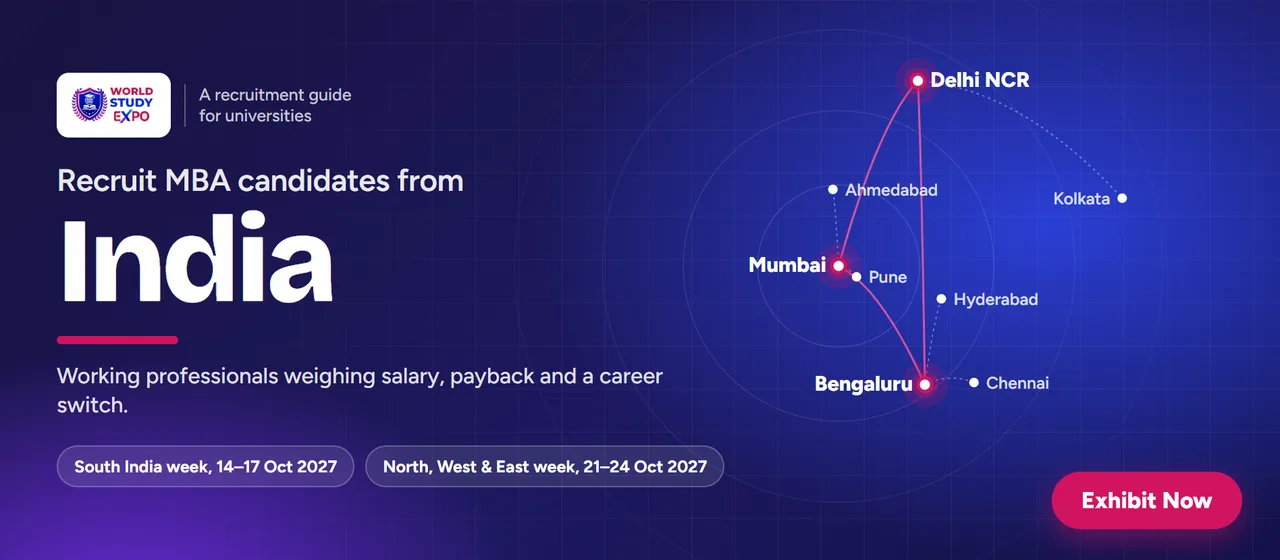
Business schools recruit Indian MBA candidates by answering the return-on-investment question with verified salary and employer data, being explicit about work-experience and test requirements, and letting candidates meet admissions staff or alumni early. Through World Study Expo, schools meet profiled MBA applicants by booked video appointment in the India Study Expo weeks, 14–17 and 21–24 October 2027.
- MBA hubs: Mumbai, Delhi NCR, Bengaluru, Pune, Hyderabad
- 5
- cities across the two India online weeks
- 20
- weekend daytime sessions suited to working professionals
- Sat–Sun
- India online weeks, Oct 2027
- 2
Who the Indian MBA candidate is
The typical international MBA applicant from India is an engineer or commerce graduate with three to eight years of work experience, often in technology, consulting, banking or manufacturing. They are weighing a career switch, a move into management, or a move abroad, and they are doing it with a spreadsheet open. Many have taken the GMAT or GRE; some are deciding between an Indian programme and an overseas one.
They are also short of time. Weekday evening and weekend appointments suit them, which is why the online weeks run Thursday and Friday evenings and Saturday and Sunday daytime.
The payback calculation
An Indian MBA candidate is giving up a salary as well as paying fees, and often borrowing. Every question they ask feeds one calculation: how long until this pays for itself?
Outcomes
“What do your graduates earn, and where?”
Publish median salary, employment rate and named employers by function, with the year of data.
Total cost
“Fees plus living, for the whole programme?”
One figure in rupees, and the documents lenders need to sanction a loan.
Work rights
“Can I work there after graduating?”
State the post-study work route for your country plainly, and how many of last year’s Indian graduates used it.
Admission
“Is my GMAT good enough? Do you waive it?”
Give the class profile range and any test-waiver policy; vague answers lose candidates to schools that are specific.
Where MBA demand sits in India
Mumbai
Finance, consulting, media
Banking and consulting professionals; strong interest in finance specialisations and one-year programmes.
Delhi NCR
Gurugram, Noida, Delhi
Consulting, technology and corporate managers; a large pool with family involvement in the decision.
Bengaluru and Hyderabad
Technology hubs
Engineers moving into product, strategy and general management.
Pune and Ahmedabad
Manufacturing and family business
Operations and supply chain demand, and family-business candidates.
MBA specialisations in demand
- Finance
- Strategy & consulting
- Product management
- Business analytics
- Marketing
- Operations & supply chain
- Entrepreneurship
- Healthcare management
- Executive MBA
One-year, two-year and specialist masters
| Format | Appeals to | Main question |
|---|---|---|
| One-year MBA | Experienced professionals minimising lost salary | Is it respected by employers? |
| Two-year MBA | Career switchers wanting an internship | Is the extra year worth the cost? |
| Specialist masters (MiM, MSc Finance) | Early-career graduates | Will it lead to a job abroad? |
| Executive or online MBA | Senior managers staying in India | Does it carry the same weight? |
The profile tells you which group a candidate falls into before you meet. For the wider postgraduate pool, see recruiting Indian postgraduate students.
Recruiting MBA candidates at the India weeks
Choose your weeks
North, West and East India for Mumbai and Delhi NCR; South India for Bengaluru and Hyderabad; or both.
We build your profile
Formats, fees, class profile, scholarships and outcomes.
Candidates register
Each states level, subject and intake, and can add work experience to their profile.
Appointments are booked
Candidates reserve slots with admissions staff or alumni you assign.
Meet them in October
Weekday evenings and weekend daytime, India time.
Follow up
Bookings and enquiries reported back for your admissions pipeline.
Before the weeks: your preparation list
- Employment report with salary, employers and year of data
- Class profile: work experience, test scores, Indian share
- Test-waiver policy and application rounds
- Total programme cost in rupees and lender-ready documents
- Scholarships for Indian or international candidates
- An Indian alumnus or alumna available for a slot or two
General guidance for institutions. Post-study work rules and lender requirements change; confirm current rules before quoting them.
Recruit MBA Candidates From India
Tell us your programmes and the team will send formats, availability and pricing for the India weeks.